Thursday, July 7, 2011

Fouad Ajami on Hayek (Presumably) on the Arab Spring


The late great Austrian economist F.A. Hayek would have seen the Arab Spring for the economic revolt it was right from the start. For generations the Arab populations had bartered away their political freedom for economic protection. They rose in rebellion when it dawned on them that the bargain had not worked, that the system of subsidies, and the promise of equality held out by the autocrats, had proven a colossal failure.


What Hayek would call the Arab world's "road to serfdom" began when the old order of merchants and landholders was upended in the 1950s and '60s by a political and military class that assumed supreme power. The officers and ideologues who came to rule Egypt, Syria, Iraq, Libya, Algeria and Yemen were men contemptuous of the marketplace and of economic freedom. As a rule, they hailed from the underclass and had no regard for the sanctity of wealth and property. They had come to level the economic order, and they put the merchant classes, and those who were the mainstay of the free market, to flight.


It was in the 1950s that the foreign minorities who had figured prominently in the economic life of Egypt after the cotton boom of the 1860s, and who had drawn that country into the web of the world economy, would be sent packing. The Jews and the Greeks and the Italians would take with them their skills and habits. The military class, and the Fabian socialists around them, distrusted free trade and the marketplace and were determined to rule over them or without them.


The Egyptian way would help tilt the balance against the private sector in other Arab lands as well. In Iraq, the Jews of the country, on its soil for well over two millennia, were dispossessed and banished in 1950-51. They had mastered the retail trade and were the most active community in the commerce of Baghdad. Some Shiite merchants stepped into their role, but this was short-lived. Military officers and ideologues of the Baath Party from the "Sunni triangle"—men with little going for them save their lust for wealth and power—came into possession of the country and its oil wealth. They, like their counterparts in Egypt, were believers in central planning and "social equality." By the 1980s, Saddam Hussein, a Sunni thug born from crushing poverty, would come to think of the wealth of the country as his own.


In Libya, a deranged Moammar Gadhafi did Saddam one better. After his 1969 military coup, he demolished the private sector in 1973 and established what he called "Islamic Socialism." Gadhafi's so-called popular democracy basically nationalized the entire economy, rendering the Libyan people superfluous by denying them the skills and the social capital necessary for a viable life.


In his 1944 masterpiece, "The Road to Serfdom," Hayek wrote that in freedom-crushing totalitarian societies "the worst get on top." In words that described the Europe of his time but also capture the contemporary Arab condition, he wrote:


..."To be a useful assistant in the running of a totalitarian state, it is not enough that a man should be prepared to accept specious justification of vile deeds; he must himself be prepared actively to break every moral rule he has ever known if this seems necessary to achieve the end set for him. Since it is the supreme leader who alone determines the ends, his instruments must have no moral convictions of their own." ...


This well describes the decades-long brutal dictatorship of Syria's Hafez al-Assad, and now his son Bashar's rule. It is said that Hafez began his dynasty with little more than a modest officer's salary. His dominion would beget a family of enormous wealth: The Makhloufs, the in-laws of the House of Assad, came to control crucial sectors of the Syrian economy.


The Alawites, the religious sect to which the Assad clan belongs, had been poor peasants and sharecroppers, but political and military power raised them to new heights. The merchants of Damascus and Aleppo, and the landholders in Homs and Hama, were forced to submit to the new order. They could make their peace with the economy of extortion, cut Alawite officers into long-established businesses, or be swept aside.


But a decade or so ago this ruling bargain—subsidies and economic redistribution in return for popular quiescence—began to unravel. The populations in Arab lands had swelled and it had become virtually impossible to guarantee jobs for the young and poorly educated. Economic nationalism, and the war on the marketplace, had betrayed the Arabs.


They had the highest unemployment levels among developing nations, the highest jobless rate among the young, and the lowest rates of economic participation among women. The Arab political order was living on borrowed time, and on fear of official terror.


Attempts at "reform" were made. But in the arc of the Arab economies, the public sector of one regime became the private sector of the next. Sons, sons-in-law and nephews of the rulers made a seamless transition into the rigged marketplace when "privatization" was forced onto stagnant enterprises.


Of course, this bore no resemblance to market-driven economics in a transparent system. This was crony capitalism of the worst kind, and it was recognized as such by Arab populations. Indeed, this economic plunder was what finally severed the bond between Hosni Mubarak and an Egyptian population known for its timeless patience and stoicism.


The sad truth of Arab social and economic development is that the free-market reforms and economic liberalization that remade East Asia and Latin America bypassed the Arab world. This is the great challenge of the Arab Spring and of the forces that brought it about. The marketplace has had few, if any, Arab defenders. If the tremendous upheaval at play in Arab lands is driven by a desire to capture state power—and the economic prerogatives that come with political power—the revolution will reproduce the failures of the past.


In Yemen, a schoolteacher named Amani Ali, worn out by the poverty and anarchy of that poorest of Arab states, recently gave voice to a sentiment that has been the autocrats' prop: "We don't want change," he said. "We don't want freedom. We want food and safety." True wisdom, and an end to their road to serfdom, will only come w


Arab people make the connection between economic and political liberty.


Mr. Ajami, a senior fellow at Stanford University's Hoover Institution, is co-chairman of Hoover's Working Group on Islamism and the International Order.


Me to some people I know:

Ajami’s lines of reasoning (understanding his is a short op ed) are these: the Arab Spring was an essentially economic revolt; an economic revolt against what?; a grand bargain struck decades ago--masses exchanging political freedom for economic protection in the form of autocracies providing for, and protecting, them; so, in the 50s and 60s in Egypt, Yemen, Syria, Iraq, Libya and Algeria a political and military class came to power ideologically hateful of markets, earned wealth and property; they sundered their country’s market economies such as they were, driving away the merchant class including enterprising Jews; Hayek’s overarching thesis bears relation to this general historical arc—in Ajami’s closing words, “the (“necessary,” my word) connection between economic and political liberty.”; Hayek argued that in totalitarian societies “the worst get on top,” writing as quoted by Ajami:

…"To be a useful assistant in the running of a totalitarian state, it is not enough that a man should be prepared to accept specious justification of vile deeds; he must himself be prepared actively to break every moral rule he has ever known if this seems necessary to achieve the end set for him. Since it is the supreme leader who alone determines the ends, his instruments must have no moral convictions of their own." …

Ajami says these words apply tellingly to Syria in particular and traces briefly why; but what happened over time was a demographic explosion making the grand bargain’s taking care and protection, (“a peculiar Hobbesian bargain,” my words) impossible; anti market centralization, of the kind Hayek inveighed against, proved a disaster—with, for two, world class unemployment and lack of female economic participation on a world scale; all this led to state terror as a mode of social control and led to rulers' "borrowed time;" overarching nepotism, self preserving and self sustaining oligarchy and true crony capitalism flayed attempts at reform; all of this was a reverse Hayekian dystopia, (my words).


Liberalized free market capitalism bypassed the Arab world and forms a great challenge to the Arab Spring.

If state power comes to the fore again, Ajami argues, it will replicate past failures. In the end, to quote Ajami, “True wisdom, and an end to their road to serfdom, will only come when the Arab people make the connection between economic and political liberty.”

Given your critique Bone, and your briefer one Jill, the question emerges whether Ajami’s analysis is too general and therefore flawed in not adequately describing the “grand bargain” occuring in the countries he specifies, before listed. (I’m whistling in the dark here because I don’t know enough to say whether the line you quote of him--"But a decade or so ago this ruling bargain—subsidies and economic redistribution in return for popular quiescence—began to unravel" (in your words) “is kind of nuts.” So let me do what I do best—niggle a bit. )

It seems to me that if Ajamai in his brief op ed is imprecise and less nuanced than he might be about the various timings of the bargains’ declines, and, if, as you say, “I think there is some of that” in his described grand bargain in the countries he listed, then I argue that “reductive” isn’t perhaps le mot juste. Sure, Ajami flattened and corralled an abundance of specifics in aid of a thesis. But the next question is, to my mind, whether he’s flogging--in your, and, more so, in Jill’s critiques--his preferred ideology and ignoring the necessary hard particulars of history in service of his flogging or whether Hayek supplies Ajami with an applicable and telling insight become an illuminating prism through which to see the Arab Spring.


I gotta’ say, no surprise, I vote for the latter alternative.


Wednesday, July 6, 2011

Paul Campos on Casey Anthony Trial and American Criminal Justice

TNR/July 7, 2011

One of the most obnoxious habits of reflexive defenders of the American legal system is their tendency to respond to any and every outcome of that system with the claim that “the system worked.” After all, as long as you never define what you mean by that claim, there’s literally no outcome that can refute it.

Nevertheless, it’s reasonable to argue that the acquittal of Casey Anthony and the apparently imminent dismissal of charges against Dominique Strauss-Kahn both represent examples of the system working as it should. But accepting that argument requires acknowledging deep imperfections that our legal system must tolerate, even when it does exactly what it’s supposed to do.

The most disturbing of these inevitable imperfections is a product of our supposed commitment to the principle that we prefer a large number—whether it’s 10, 50, or 100, the precise number is never clearly stated—of guilty people going free to the conviction of an innocent defendant. That is the practical significance of requiring the state to prove guilt “beyond a reasonable doubt”—a standard that, interestingly, the system always avoids defining in any but the most general, non-statistical terms.

Our commitment to this principle is tested most severely in cases involving a heinous crime, an unsympathetic defendant, and a body of evidence that strongly suggests the defendant’s guilt, while still featuring gaps that make the prosecution’s case less than completely compelling. And that is a fair description of what the jury deciding Casey Anthony’s fate had to deal with.

The state proved beyond a reasonable doubt that a two-year-old child was murdered, and that her mother was, at the least, a deeply irresponsible parent with a propensity to lie to authorities. The prosecution also demonstrated, in my view, that it is far more likely than not that Anthony committed the crime.

But I also believe the jury’s verdict was correct.

Since our system more or less leaves it up to each of us to decide what “reasonable doubt” ought to mean, my own standard is this: Would I be shocked to discover that in fact Casey Anthony was innocent? Not surprised, not startled, but shocked—in the way, for example, that I would be genuinely shocked to learn that O.J. Simpson did not murder his ex-wife. That, it seems to me, is a reasonable interpretation of what “beyond a reasonable doubt” should mean, if we are serious about the idea that mistaken acquittals are vastly preferable to wrongful convictions.

The case against Anthony was largely circumstantial, buttressed by arguably—yet only arguably—strong forensic evidence. But the prosecution was hampered by its inability to provide a compelling narrative explaining either how Caylee Anthony was killed or why her mother purportedly murdered her. This failure was not, as far as we know, a product of prosecutorial incompetence.

The hard truth is that it is extremely difficult to successfully prosecute a murder under these kinds of circumstances—and the harder truth is that we are supposedly committed to the principle that this is, on the whole, a good thing.

The case against Strauss-Kahn presents its own collection of hard truths. Foremost among them is that sexual assault is a particularly difficult crime to prosecute—for both good and very bad reasons.

The good reason it’s difficult to convict defendants accused of rape is that, as a general matter, we should be reluctant to conclude, in cases that turn exclusively on conflicting testimony, that we are certain beyond a reasonable doubt which person is telling the truth and which one is lying (social scientists have demonstrated that people tend to greatly overestimate their ability to accurately assess such things).

The bad reasons are many: As feminists have been pointing out for decades, sexual assault is a crime that is often normalized to the point of rendering it practically invisible, and one that is especially prone to generate victim-blaming. But given the circumstances, it’s hard to criticize either the NYPD or the district attorney’s office for how they handled the case.

Faced with an apparently credible sexual assault accusation and a defendant who appeared to be fleeing the country, the authorities moved quickly—and when problems arose with the prosecution, they moved just as quickly to reveal them to DSK’s defense. That, after all, is how the system is supposed to work.

None of this is to deny that the outcome of both cases is not in many ways deeply disturbing. It is much more likely than not that Casey Anthony has gotten away with murder. And while we cannot be sure that a crime was committed in the DSK matter, the sight of a rich white man who has now been the subject of multiple sexual assault accusations walking away from a poor black woman’s claim that he raped her is something that should always disturb us.

Yet in the end, the unsatisfactory nature of these outcomes is the price we are supposed to be willing to pay to avoid travesties such as the state of Texas engaging in something resembling outright judicial (and gubernatorial) murder. It is indeed a high price—but the price of not paying it is even higher.

Paul Campos is professor of law at the University of Colorado.

Me:

The paradox: it's more likely than not that Casey Anthony killed her daughter but it's right that she was acquitted. It's right because one can have a reasonable doubt but still believe such and such was the case on the balance of probabilities. Reasonable doubt is the criminal standard of proof that has to be met. The balance of probabilities is the civil standard of proof a plaintiff needs to satisfy to win his case.

Tuesday, July 5, 2011

David Brooks on Republican Party Circa July 4, 2011

NYT/July 4, 2011

The Republicans have changed American politics since they took control of the House of Representatives. They have put spending restraint and debt reduction at the top of the national agenda. They have sparked a discussion on entitlement reform. They have turned a bill to raise the debt limit into an opportunity to put the U.S. on a stable fiscal course.

Republican leaders have also proved to be effective negotiators. They have been tough and inflexible and forced the Democrats to come to them. The Democrats have agreed to tie budget cuts to the debt ceiling bill. They have agreed not to raise tax rates. They have agreed to a roughly 3-to-1 rate of spending cuts to revenue increases, an astonishing concession.
Moreover, many important Democrats are open to a truly large budget deal. President Obama has a strong incentive to reach a deal so he can campaign in 2012 as a moderate.

The Senate majority leader, Harry Reid, has talked about supporting a debt reduction measure of $3 trillion or even $4 trillion if the Republicans meet him part way. There are Democrats in the White House and elsewhere who would be willing to accept Medicare cuts if the Republicans would be willing to increase revenues.

If the Republican Party were a normal party, it would take advantage of this amazing moment. It is being offered the deal of the century: trillions of dollars in spending cuts in exchange for a few hundred billion dollars of revenue increases.

A normal Republican Party would seize the opportunity to put a long-term limit on the growth of government. It would seize the opportunity to put the country on a sound fiscal footing. It would seize the opportunity to do these things without putting any real crimp in economic growth.

The party is not being asked to raise marginal tax rates in a way that might pervert incentives. On the contrary, Republicans are merely being asked to close loopholes and eliminate tax expenditures that are themselves distortionary.

This, as I say, is the mother of all no-brainers.

But we can have no confidence that the Republicans will seize this opportunity. That’s because the Republican Party may no longer be a normal party. Over the past few years, it has been infected by a faction that is more of a psychological protest than a practical, governing alternative.

The members of this movement do not accept the logic of compromise, no matter how sweet the terms. If you ask them to raise taxes by an inch in order to cut government by a foot, they will say no. If you ask them to raise taxes by an inch to cut government by a yard, they will still say no.

The members of this movement do not accept the legitimacy of scholars and intellectual authorities. A thousand impartial experts may tell them that a default on the debt would have calamitous effects, far worse than raising tax revenues a bit. But the members of this movement refuse to believe it.

The members of this movement have no sense of moral decency. A nation makes a sacred pledge to pay the money back when it borrows money. But the members of this movement talk blandly of default and are willing to stain their nation’s honor.

The members of this movement have no economic theory worthy of the name. Economists have identified many factors that contribute to economic growth, ranging from the productivity of the work force to the share of private savings that is available for private investment. Tax levels matter, but they are far from the only or even the most important factor.

But to members of this movement, tax levels are everything. Members of this tendency have taken a small piece of economic policy and turned it into a sacred fixation. They are willing to cut education and research to preserve tax expenditures. Manufacturing employment is cratering even as output rises, but members of this movement somehow believe such problems can be addressed so long as they continue to worship their idol.

Over the past week, Democrats have stopped making concessions. They are coming to the conclusion that if the Republicans are fanatics then they better be fanatics, too.

The struggles of the next few weeks are about what sort of party the G.O.P. is — a normal conservative party or an odd protest movement that has separated itself from normal governance, the normal rules of evidence and the ancient habits of our nation.

If the debt ceiling talks fail, independents voters will see that Democrats were willing to compromise but Republicans were not. If responsible Republicans don’t take control, independents will conclude that Republican fanaticism caused this default. They will conclude that Republicans are not fit to govern.

And they will be right.

Howard Jacobson on Alice Walker on the Flotilla, Round 2

June 26/CNN

It should not need arguing, this late in the ethical history of mankind, that good people can do great harm. One of the finest and funniest novels ever written — Don Quixote — charts the damage left in the wake of a man who would make the world a better place.

Human beings are seldom more dangerous than when they are sentimentally overcome by the goodness of their own intentions. That Alice Walker believes it is right to join the Freedom Flotilla II to Gaza I do not have the slightest doubt. But beyond associating her decision with Gandhi, Martin Luther King and very nearly, when she talks about the preciousness of children, Jesus Christ, she fails to give a single convincing reason for it.

“One child must never be set above another child,” she says. A sentiment that will find an echo in every heart. But how does it justify the flotilla? Gaza is under siege, Israelis will tell you, because weapons are fired from it into Israel, threatening the lives of Israeli children. If the blockade is lifted there is a fear that more lethal and far-reaching weapons will be acquired, and the lives of more Israeli children endangered.

You may want to argue that had Gaza been treated differently it would have responded differently, but if the aim of the flotilla is to ensure that one child will not be set above another it is hard to see how challenging the blockade will achieve it. All an Israeli parent will see is a highly charged emotionalism disguising an action that, by its very partiality, chooses the Palestinian child over the Israeli.

The boat on which Alice Walker will be traveling is called The Audacity of Hope. Forgive me for seeing a measure of self- importance in that reference. It will be carrying, Alice Walker tells us, “Letters expressing solidarity and love.” Not, presumably, for Israeli children. Perhaps it is thought that Israeli children are the recipients of enough love already. So what about solidarity? It is meant to sound innocuous. “That is all.”

Alice Walker makes plain, “its cargo will be carrying.” But what will these letters of solidarity be expressing solidarity with? Solidarity is a political term implying commonality of interest or aspiration. So what interest or aspiration do Alice Walker and her fellow travelers share with the people of Gaza? A desire for freedom? Well we all aspire to that. A longing to live in peace?

If they have such a longing we must be solid with them in that too, though the firing of rockets from Gaza is not, on the face of it, an expression of such a longing. And what about the declared hostility of Hamas to the very existence of Israel? Hamas, we are often told, is the elected government of Gaza, a government that fairly represents the wishes of its people. In which case we must assume that Hamas’s implacable hostility towards Israel fairly represents the implacable hostility felt by the people of Gaza. Are Alice Walker’s letters of love and ‘solidarity’ solid with the people of Gaza in that hostility?

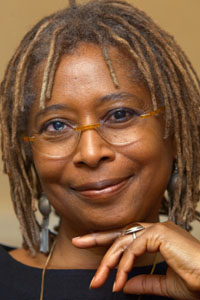
Alice Walker, writer of 'The Colour Purple'

“If the Israeli military attacks us, it will be as if they attacked the mailman,” she says. Wrong on a thousand counts. As a writer, Alice Walker must understand the symbolic significance of words. The cargo is a cargo of intention. It is freighted with political sympathy and attitude. It means to blunder into where it isn’t safe, clothed in the make-believe garments of the unworldly, speaking of children and speaking like children, half inviting a violence which can then be presented as a slaughter of the innocents.

Even before the deed, Alice Walker has her language of outraged moral purity prepared — “but if they insist on attacking us, wounding us, even murdering us…” The Israeli response is thus already an act of unprovoked murder, no matter that the flotilla is by its very essence a provocation.

Whatever its cargo, by luring the Israeli military into action which can be represented as brutal, the flotilla is engaged in an entirely political act. To call it by any other name is the grossest hypocrisy.

Alice Walker might be feeling good about herself, but by giving the Palestinians the same old false comfort we’ve been doling out for more than half a century, and by allowing the Israelis to dismiss it as yet another act of misguided and uncomprehending adventurism — further evidence that its fears go unheeded – her political gesture only worsens the situation. The parties to this conflict need to be brought together not divided: but those who speak disingenuously of love will engender only further hatred.

Monday, July 4, 2011

Stanley Fish on SCOTUS on Limits on First Amendment Free Speech

July 4, 2011/NYT

What Does the First Amendment Protect?

In the two First Amendment cases handed down last week — one about limiting sales of violent video games to children, the other about Arizona’s attempt to make public financing more attractive to candidates — the dissenting justices contend that the protection of speech is not really the issue at all.

In his dissent to Brown v. Entertainment Merchants, Justice Stephen Breyer declares that this is not a case, as the majority claims, about “depictions of violence”; rather it is a case about “protection of children.” What Breyer is doing (or attempting to do) is shift the category under which the matter of dispute is to be considered. According to Justice Antonin Scalia, writing for the majority, depictions of violence merit First Amendment protection because they are speech, not acts.

Breyer replies that the video games in question are in fact acts, although they are, he acknowledges, acts “containing an expressive component.” That component, he argues, does not outweigh or render irrelevant the “significant amount of physical activity” involved in playing these games, activity in the course of which players do not merely see violent things but do violent things.

The danger Breyer wants to protect children from is not the danger of being exposed to violence, but the danger of being initiated into violence. This happens (or can happen) when game-players are required not merely to view violent acts passively, but to perform them by making a succession of choices (with a button or joystick) that decide the fate of the characters they have created.

Justice Samuel Alito, who concurs in the result because he believes the law to have been poorly drafted but disagrees with the majority’s reasoning, provides an example. Compare, he says, the reader of a novel depicting violence with a video-game player “who creates an avatar that bears his own image; who sees a realistic image of the victim … in three dimensions; who is forced to decide whether or not to kill the victim and decides to do so; who then pretends to grasp an axe, to raise it above the head of the victim; who hears the thud of the axe hitting her head and her cry of pain; who sees her split skull and feels the sensation of blood on his face and hands.”

Are these experiences the same?, Alito asks, and answers no.

The difference, which Scalia labors to deny (“Certainly the books we give to children … contain no shortage of gore”), is sufficient, Alito thinks, to justify the state’s interest in regulation, even though he finds the present attempt at regulation flawed.

Breyer frames the issue precisely when he declares, “This case is ultimately less about censorship than it is about education.” Education is important in a democracy, he explains, because it gives us a means of raising “future generations committed cooperatively to making our system of government work.”

The implication is that a generation immersed in violent video-games will be committed not to cooperation but to actions less helpful to the flourishing of the country.

Justice Clarence Thomas, writing another dissent disguised as a concurrence, shares Breyer’s concern that children be protected from influences that might turn them into damaged citizens. He reminds us of Noah Webster’s admonition that children’s minds be “untainted till their reasoning faculties have acquired strength and the good principles which may be planted … have taken deep root”; and he cites a 1979 opinion in which Justice Lewis F. Powell declares that “the State is entitled to adjust its legal system to account for children’s vulnerability.”

Children are vulnerable, according to this theory, because they have not yet developed the ability to distance themselves from what is put before them. Interactive video games increase this vulnerability and lead not merely to the consuming of bad images, but to the possibility of becoming a bad person. This is the corruption that will follow, Alito fears, from allowing “troubled teens to experience in an extraordinarily personal and vivid way what it would be like to carry out unspeakable acts of violence.”

Breyer drives the point home: “…extremely violent games can harm children by rewarding them for being violently aggressive in play, and thereby often teaching them to be violently aggressive in life.” Violent video games, in short, are not representations that deserve First Amendment protection; they are acts with harmful consequences and children deserve to be protected from them.

Although its subject matter could not be more different, Arizona Free Enterprise v. Bennett, displays the same opposition between a libertarian concern for freedom and a consequentialist concern for the corruption that attends unregulated activity. In this case it is not a child but the political system that is in danger of corruption, and the source of corruption is not a violent game but the desire of private individuals to purchase the votes of office-holders.

That at least is the view of Justice Elena Kagan, writing in dissent: “Campaign finance reform over the last century has focused on one key question: how to prevent massive pools of private money from corrupting our political system.” In Kagan’s formulation, “private money” equals “special interests,” whereas those who “rely on public, rather than private moneys, are ‘beholden [to] no person.’” Therefore by “supplanting private cash, public financing eliminates the source of political corruption.”

No says Chief Justice John G. Roberts, writing for the majority. Arizona’s public financing scheme, he contends, is an unconstitutional restriction on free speech because it penalizes privately financed candidates for being successful. Expenditures by privately financed candidates and the groups supporting them trigger the awarding of matching funds to candidates who have accepted the limits that come along with public funding.

Roberts concludes that “any increase in speech is of one kind … that of publicly financed candidates.” So even if “the matching funds provision did result in more speech … in general, it would do so at the expense of impermissibly burdening (and thus reducing) the speech of privately financed candidates.”

But that parentheses — “and thus reducing” — is a little too fast. How exactly does the fact that in response to your expenditures an opponent with fewer resources will be given additional funds reduce your speech?

You can still get to spend as much as you want and to say as much as you want. What you don’t get to do is overwhelm the voices of less affluent candidates and their supporters. As Kagan points out, “what petitioners demand is essentially a right to quash others’ speech … they would prefer the field to themselves, so that they can speak free from response.” The Arizona law, she adds, can hardly be characterized as a restriction on speech..

It follows, Kagan asserts, that “public financing furthers a compelling interest” — the prevention of corruption — and does so without diminishing anyone’s speech rights. The conclusion, she believes, is inescapable “[e]xcept in this Court,” where the majority declares that the state interest in leveling the playing field “cannot justify undue burdens on political speech.”

But, to make the point again, there is no burden unless being prevented from being the only speaker with a megaphone is a burden, and it is not. In the majority decision, a compelling state interest is set aside because of a restriction on speech that has not occurred.

In some exasperation, Kagan remarks, “Only one thing is missing from the Court’s response: any reasoning to support [its] conclusion.” That’s not quite right. The reasoning is contained in an assumption that is the reverse of Kagan’s: private money, rather than being the vehicle of corruption, is the vehicle of speech, and therefore you can’t have too much of it, no matter what its effects.

The First Amendment, says Roberts, “embodies our choice as a Nation that, when it comes to … speech, the guiding principle is freedom—the ‘unfettered interchange of ideas’ — not whatever the State may view as fair.”

Roberts does not have to reply to Kagan’s points — he can even concede them — because in his view they are irrelevant. “When it comes to protected speech, the speaker is sovereign.” Other considerations (like corruption and fairness) may be in play, but the rights of the speaker — in this case the rights of the spender — are paramount.

They are what the First Amendment protects. Kagan disagrees: “The First Amendment’s core purpose is to foster a healthy vibrant political system full of robust discussion and debate,” and the Arizona law, with its mechanism for increasing participation is, she maintains, true to that purpose.

And there you have it: a clash between the worship of freedom of speech and a concern for the quality of public life in relation to which free speech may sometimes be asked to take a back seat. It is the same clash that pits the freedom to play video games against society’s interest in fostering a generation of young adults responsive to its ideals and aspirations.

We have seen this before — in the pornography cases, in the crush-video case, in the case upholding the right of an anti-gay ministry to picket the funerals of soldiers — and we shall certainly see it again.

Clarence Thomas on First Amendment Free Speeech Not Applying to Minors

Robert Barnes/WaPo/July 3, 2011

Justice Clarence Thomas last week called upon “father of liberalism” John Locke, 18th-century philosopher Jean-Jacques Rousseau, the Puritan tradition, and American icons Thomas Jefferson and Noah Webster to announce a constitutional finding that his colleagues considered startling:

The First Amendment does not convey a free-speech right when minors are involved.

Thomas dissented from the court’s decision in Brown v. Entertainment Merchants Association that violent video games, like books and movies, are protected forms of free speech. The ruling found that California’s ban on the sale or rental of such games to those under 18 violated the Constitution.

That could not be so, Thomas said.

“The Framers could not possibly have understood ‘the freedom of speech’ to include an unqualified right to speak to minors,” Thomas wrote. “Specifically, I am sure that the founding generation would not have understood ‘the freedom of speech’ to include a right to speak to children without going through their parents.”

Thomas’s argument was the logical extension of his “originalist” position that the Constitution’s provisions be discerned by the most likely public understanding at the time it was adopted.

But his dissent was even more intriguing because the author of the court’s majority decision was the court’s other originalist, Antonin Scalia. He addressed Thomas in a footnote:

“He cites no case, state or federal, supporting this view, and to our knowledge there is none,” Scalia wrote.

“What would the Founders do?” had been part of the case from the start. At oral arguments, Scalia was adamant that depictions of violence had never been found to lack First Amendment protection.

Justice Samuel A. Alito Jr. jibed: “What Justice Scalia wants to know is what James Madison thought about video games.”

“No,” Scalia snapped, “I want to know what James Madison thought about violence.”

Thomas, on the other hand, wanted to know what Madison and the others thought about children.

After consulting Locke and Rousseau, examining Jefferson’s demanding schedule for his daughter (“dictating her daily schedule of music, dancing, drawing and studying”) and noting Webster’s concern for what children read (“Vice always spreads by being published,” he said), Thomas had an answer.

“The history clearly shows a founding generation that believed parents to have complete authority over their minor children and expected parents to direct the development of those children,” he wrote.

In Thomas’s works about the duties of parents, it is easy to conjure the image of his iron-willed grandfather, Myers Anderson, who raised Thomas after the justice’s father abandoned the family. Anderson was a strict disciplinarian who wouldn’t let Thomas play on sports teams or join the Cub Scouts but who saved Thomas from a life of poverty and neglect, Thomas wrote in his book “My Grandfather’s Son.”

Thomas has expressed, in previous court cases, his belief that minors have limited rights to protest school officials’ decisions, and he said in the California case that “the question is not whether certain laws might make sense to judges or legislators today, but rather what the public likely understood ‘the freedom of speech’ to mean when the First Amendment was adopted.”

Scalia dismissed Thomas’s argument but did not engage in an originalist debate. He said the view “ignores” court precedent about the rights of minors. And he said it could criminalize allowing minors to attend political events or even church without parental permission.

Liberal commentators have said Thomas’s dissent is another example of extreme views — no other justice signed on. But even some who study originalism said Thomas failed to make his case.

“I guess I would say it’s a little underdeveloped,” University of San Diego law professor Michael Rappaport said diplomatically. Rappaport runs the law school’s Center for the Study of Constitutional Originalism.

In an interview and in a posting on the Originalism Blog, Rappaport said attitudes about children at the time the First Amendment was written don’t necessarily mean that freedom of speech did not extend to children.

Fellow professor Michael D. Ramsey, a former Scalia clerk, agreed the theory needed work. “I have doubts whether one can reliably infer specific legal conclusions from general social attitudes,” Ramsey wrote. “That Jefferson was a controlling father doesn’t say much about [daughter] Martha’s legal right to talk to others without his permission.”

But neither was prepared to say flatly that Thomas was wrong, and Rappaport said he may well be right.

Originalism is still a relatively young theory of constitutional interpretation, he said, and “there’s still a lot of work that needs to be done.”

Great Legal Work: It takes Close Reading But Is Well Worth It

1. http://tiny.cc/kdhus

then

2. http://tiny.cc/ke99d